
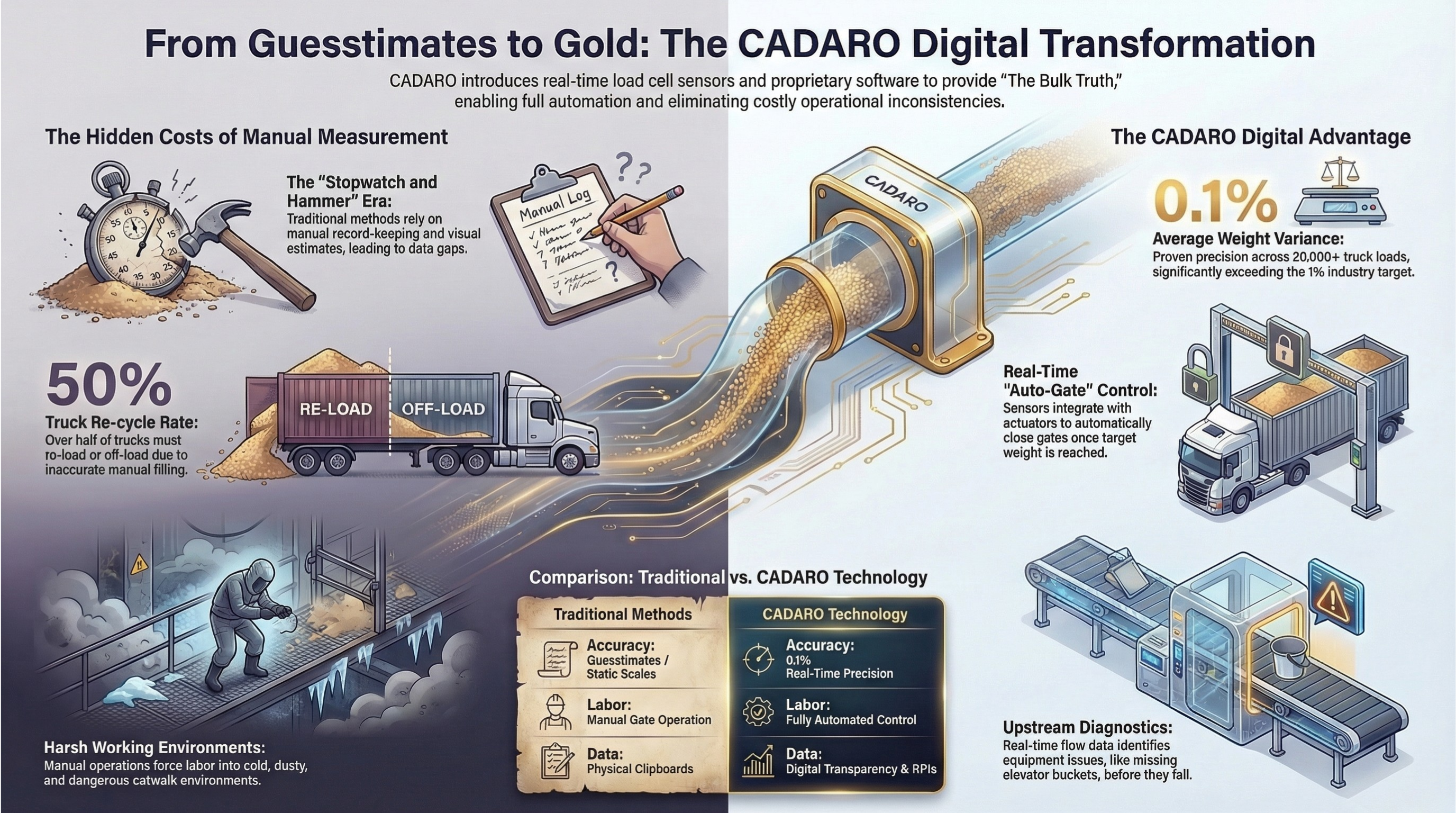
In an era defined by hyper-precise logistics and real-time data analytics, the bulk material handling industry remains a curious outlier. While high-tech sectors obsess over millisecond efficiencies, much of the global supply chain for dry flowables still relies on a surprisingly primitive toolkit: stopwatches, clipboards, and the time-honored tradition of banging on a bin with a hammer to "guesstimate" inventory.
This reliance on intuition over information creates a fundamental management gap. In a world where razor-thin margins are the norm, "guesstimation" isn't just an operational quirk—it is a balance sheet liability. To bridge this divide, a new philosophy is emerging: "The Bulk Truth." It is rooted in the inescapable reality that you cannot manage what you do not measure. By replacing manual estimation with digital transparency, facilities are discovering that the distance between "close enough" and "perfectly optimized" is the difference between an industry laggard and a market leader.
The Costly "Guessing Game" of the Vanishing Veteran
For decades, the accuracy of truck and rail loading has rested on the shoulders of experienced operators. These veterans possess an almost supernatural "feel" for material flow, yet they are becoming increasingly difficult to find and impossible to replicate. When they retire, their intuitive knowledge leaves with them.
The result is a staggering inefficiency: currently, more than 50% of trucks are "cycled." They are loaded, sent to the scale, found to be overweight or underweight, and forced to return to the bin for adjustment. This is more than a minor delay; it is a triple-threat cost center:
- Liability: Modern corporations can no longer ignore the legal and safety risks of overweight vehicles leaving their gates.
- Fines: Overloading rail cars triggers immediate, heavy penalties.
- The Triple Cost of Disposal: If a car is found over-capacity downstream, the facility pays the fine, pays for the material removal, and pays for the disposal of the excess product.
In this context, a digital flow sensor isn't just a piece of hardware; it’s a strategy for labor resilience and risk mitigation.
The "Upstream MRI": Flow Rate as a Diagnostic Tool
A digital flow sensor is often misperceived merely as a scale. In reality, it serves as a diagnostic "MRI" for the entire mechanical process. By providing a real-time digital display of exactly what is happening inside a chute or pipe, these sensors reveal "hidden inconsistencies" that are invisible to the naked eye.
Consider the bucket elevator. An inconsistent flow rate on a digital display can act as a heartbeat monitor, signaling that the elevator is missing buckets or failing mechanically long before a catastrophic shutdown occurs. This moves material handling from reactive repair to proactive, data-driven preventative maintenance. As CADARO leadership notes, "Data is gold." It enables a digital transformation where managers can finally set KPIs, hold teams accountable, and understand the true yield of their facility—what came in versus what actually went out.
The Soybean Paradox: Engineering for Fragility
The origin story of this technology is rooted in a specific academic and engineering challenge. A multinational seed company faced a paradox: they needed to measure soybean seeds with high precision as they entered the plant, but they could not risk damaging the "germ" or the quality of the seed.
Traditional "strike plate" methods, where material hits a surface with enough force to generate a reading, often degrades the product. Challenged with this problem, two professors developed a patented method of measuring material based on pressure on a load cell in vertical or incline applications. By capturing signals and converting them via proprietary software into real-time weight and flow data, they achieved precision with virtually no impact on the product. What began as a niche solution for fragile soybeans has become a universal standard for anything "dry and flowable."
From the Catwalk to the Control Room
The digital transformation of the bulk industry is as much about human capital as it is about sensors. Historically, operators have been required to work in brutal environments, manually opening and closing gates on catwalks amidst dust, noise, and the sub-zero temperatures of Midwest winters.
By integrating flow sensors with automated actuators and RFID "digital handshakes," the workflow is revolutionized. Using RFID sensors to capture truck tare weights automatically, an operator in a climate-controlled office can simply input a target weight—say, 50,000 pounds—and hit "start." The system manages the flow and triggers a precision gate closure the moment the target is reached. This shift allows the workforce to move to "higher-value tasks," transforming a job people used to endure into a career they actually want to sign up for.
Precision at Scale: Shattering Historical Standards vs. the 1% Standard
In Dry Bulk Solids Material Handling and Processing, there is no universal “industry standard” for flow accuracy because every plant’s material, equipment, and operating conditions behave differently. That is exactly why CADARO takes a clear, practical position: our target is typical accuracy within +/- 1% when the sensor is correctly selected, installed, and calibrated for the application.
What makes that target meaningful is what customers see in real commercial environments. In a large longitudinal dataset covering more than 26,000 truck loads, operations using INTEGRAL series (incline, handling roughly 2,000 to 50,000 lbs/min) reported average results around 0.1% in that specific setup. That is not a promise that every site will achieve 0.1%, but it is strong evidence of what is possible when the process is stable and hidden inconsistency is exposed and controlled. In a space where skepticism is earned and over-promising is common, this is the point: CADARO claims what we can stand behind, and customers are often seeing performance that beats the claim.
The $15 Billion Competitive Divide
The bulk material industry is facing a crossroads. The total addressable market for this technology is estimated at $10 billion, but there is an "invisible market"—the traditional means of manual estimation—that is actually larger than the current market itself. This means the biggest competitor isn't another company; it is the "Hammer."
The barrier to entry for this digital shift has vanished. Through flexible models ranging from traditional CAPEX ownership to the "CADARO’s Complete" OPEX subscription, facilities can now adopt these tools without massive upfront capital.
As labor markets tighten and global competition intensifies, the divide between those who "guesstimate" and those who know the "Bulk Truth" will only widen. In an industry where every pound and every minute counts, the question is no longer about the cost of the technology. It is about the cost of the status quo. Can you afford to keep guessing your bottom line?

Join the Conversation