
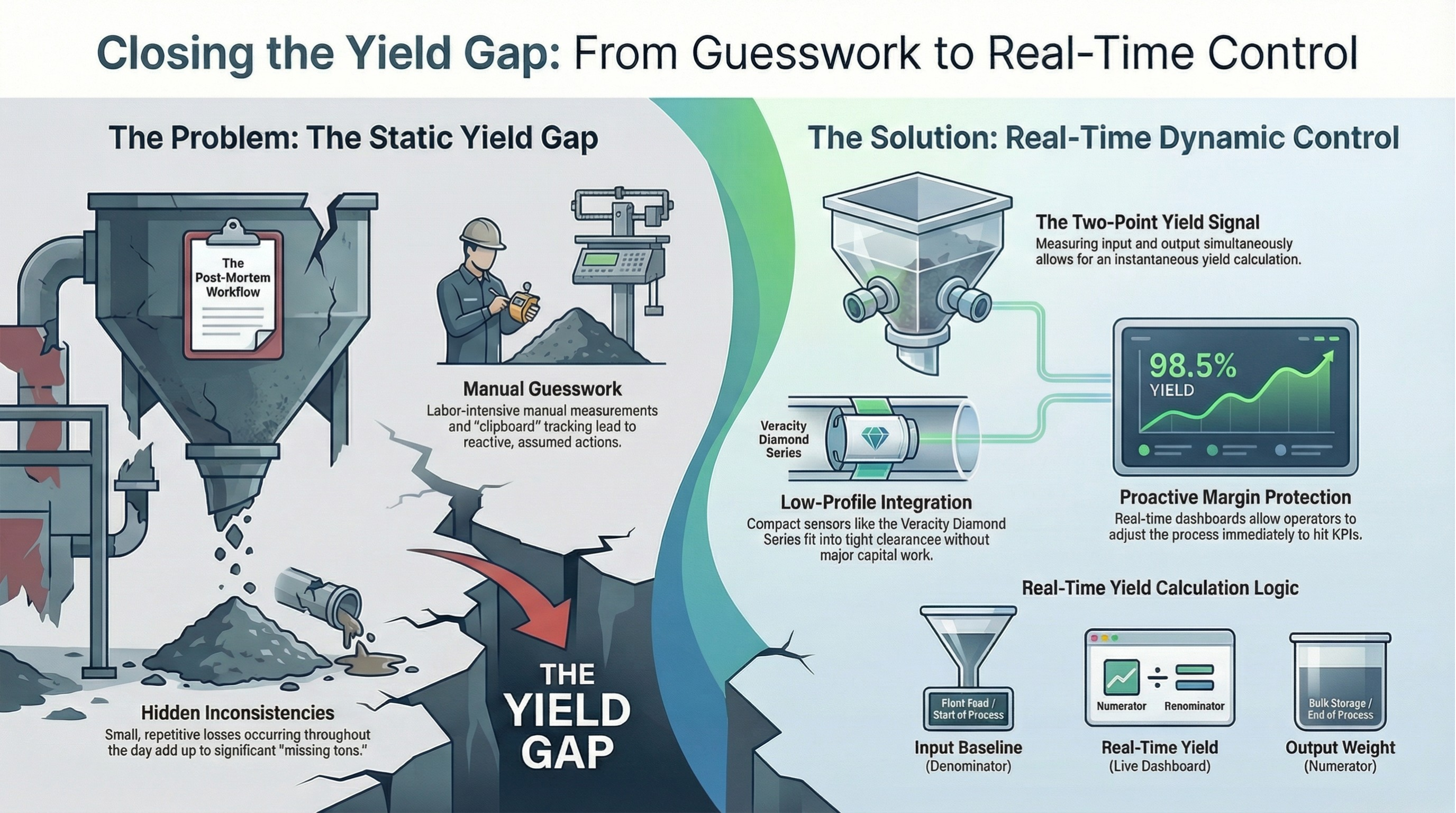
The Hook: Why Yield is Not a Feeling
In the high-stakes world of bulk material processing, "gut feeling" is a liability that scales into a multi-million-dollar deficit. After traveling six thousand miles in two weeks and visiting several grain processing plants, the reality on the ground is clear: many facilities are operating in the dark. While a plant might appear to be humming along, the true story is often told through missing tons that simply vanish between the intake and the load-out.
This discrepancy is what we call the "Yield Gap." It is the distance between what you assume is happening and the hard reality of your material flow. These insights, forged from CADARO’S expertise in flow sensors, reveal that the traditional reliance on "post-mortem" accounting is no longer enough to maintain a competitive margin in modern industry.
The "Post-Mortem" Trap vs. Real-Time Awareness
Managing a processing plant through end-of-month reconciliation is like trying to manage a bank account by only looking at the statement thirty days late. You might eventually identify a discrepancy, but by then, the money is spent and the errors are buried. This reactive approach confirms a failure after it is far too late to change the outcome, leaving operators in a perpetual cycle of playing catch-up.
Digital transformation requires a shift toward real-time dynamic weights. By moving from the "Left" of the process (Reactive/Assumed) to the "Right" (Proactive/Data-Driven), managers gain the ability to make instant adjustments. Instead of wondering where the material went, CADARO technology provides the transparency needed to solve problems the moment they occur.
The Villain is Small and Repetitive
The "villain" in industrial processing is rarely a single, catastrophic equipment failure that everyone notices. Instead, the true enemy is "unexplained shrink"—the tiny, repetitive inconsistencies that occur hundreds of times a day. Because these micro-losses are invisible to the naked eye, they are often dismissed as the cost of doing business.
However, these small leaks aggregate into massive numbers, resulting in the missing tons that erode annual profitability. CADARO flow sensors act as a spotlight on these hidden villains, creating a repeatable, static process. By quantifying exactly what is moving through the facility, plants can finally eliminate the "ghost" losses that manual clipboards simply cannot track.
The Simplest Math: Tuning the Two-Point Yield Signal
Calculating yield in real-time is not an exercise in complex calculus; it is the strategic application of a "Two-Point Yield Signal." To begin, you must establish the "Denominator"—the absolute input baseline feeding into the plant. Whether it is a shift or a specific batch of grain, this is the ground truth of what entered the system.
The second point is the "Numerator," or the actual output measured at the back end of the process. By comparing these two points as the material moves, the plant becomes a live feedback loop. This allows operators to see the immediate impact of process adjustments, turning the facility into a finely tuned instrument rather than a black box of guesswork.
The Clearance Hurdle: Why Hardware Size Matters
A primary barrier to digital transformation in legacy grain processing plants is the "clearance hurdle." Most facilities were designed decades ago with zero consideration for modern sensor integration. Finding the physical space to install traditional, bulky measurement equipment often requires massive capital expenditure and structural overhaul.
This is where the CADARO VERACITY Diamond series changes the equation. Designed with an ultra-low profile, these sensors are built for the tight constraints of existing lines where clearance is at a premium. This compactness and flexibility allow for a rapid "proof of concept" without the need for a total facility redesign, making high-level data accessible to older infrastructure.
Reclaiming "Dead Labor" from the Tribal Knowledge Gap
Manual inventory measurement—climbing bins, hitting tanks with hammers, and guesstimating levels—is "dead labor." It is an expensive, high-risk activity that adds zero value to the final product. Furthermore, the accuracy of these manual "true-ups" is often fictional, leading to accounting reconciliations that are more about closing the books than finding the truth.
This reliance on manual labor has reached a crisis point as the industry’s most experienced operators begin to age out. Replicating thirty years of "tribal knowledge" in a new hire is a near-impossible task in today's labor market. Automation allows facilities to institutionalize that expertise, using real-time dashboards to backfill the loss of veteran workers and ensure consistency regardless of who is on the clock.
"You're just trying to see where all the bodies are at... you're going to get reconciliation when it comes to accounting... whether it's accurate or not, that's another question."
The Future of the Bulk Truth
The transition from reactive guesswork to proactive control is the only path forward for high-margin processing. By establishing real-time KPIs, companies can finally understand their true feed rates and reclaim their missing tons. This shift doesn't just improve the books; it changes the entire operational culture from one of explanation to one of optimization.
To facilitate this transition, CADARO is offering "2026 sessions" featuring a unique subscription model for the VERACITY Diamond series. This program allows companies to "try before they buy," using their own real-world data to build a bulletproof business case for CapEx approval by the end of 2026. As you look at your facility today, ask yourself: How much of your margin is currently being stolen by hidden villains, and how much longer can you afford to operate on a feeling?

Join the Conversation